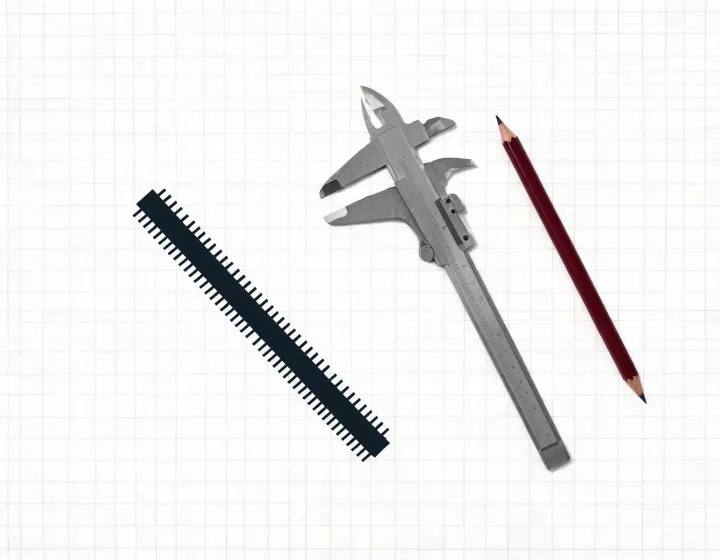
Lines each supplier should price the same way
A 0.100 inch header looks common, which is why quotes drift. One factory prices the housing, another prices loose contacts, a third prices a reel with a tooling note. The ledger below is the minimum set to request. It is not a claim that any factory already meets it.
| Line | What to demand in the quote | Why it changes money |
|---|
| Pitch and rows | 0.100 inch (2.54 mm), single or dual row, positions | A dual-row footprint is a different tool |
| Tail | Solder, press-fit, or surface-mount, plus tail length and board thickness | Press-fit tooling is not in a solder price |
| Plating | Tin, or gold thickness such as 15 µin or 30 µin over nickel | Gold thickness is a metal cost, not a slogan |
| Mate | Crimp housing, board socket, or shrouded header, sold together or not | A header-only price excludes the cable side |
| Commercial basis | Quantity, currency, per piece or per reel, Incoterm, destination | Unit price without freight is not a landed cost |
Costs that must stay visible as exclusions
Ask the supplier to list, as separate lines or as explicit exclusions: contact reels, housings, polarization keys, pick-and-place caps, first-article samples, plating lot charges, export packing, freight, duty, and incoming inspection. A sample of 10 pieces is not the production MOQ. If the factory names a minimum, record the number and the unit. Do not treat a verbal minimum as a site fact.
Current and voltage stay on the datasheet. Request the rating condition, often a 20°C or 30°C temperature rise, rather than a single ampere figure with no ambient. If the pins carry a differential pair, also ask whether impedance is controlled. A 2.54 mm header is often a power or low-speed interconnect. Calling it a controlled-impedance part without a stack-up is a scope change.
Sourcing scenario: a repair buyer asks for a pcb connector 01 inch drop-in and receives a 2.00 mm quote because the seller grouped fine-pitch headers together. Background is a field replacement on a CPE board. Process is to mark 2.54 mm as mandatory and 2.00 mm as out of scope. Result is a second request that cannot be averaged with the first price.
TIA-568 can frame a question about the cable plant the plug joins, such as category and pair count. It does not approve the board connector. EIA-364 style mechanical tests, when a supplier cites them, should name the method and the sample size. Connector mating cycle numbers without a method are notes, not acceptance criteria.
Two sourcing choices stay open on a 0.100 inch line. An OEM-coded footprint may align with the host maker support policy, while a compatible outline may be quoted when the buyer accepts a labeled deviation. A new reel has a clearer plating record than a refurbished or surplus header, which can still match pitch and fail a wear check. Quote both only when the brief asks for both, and do not merge the prices.